

What comes before words
If your child isn't talking yet — or isn't talking as much as you'd expect — it's natural to focus on words. Words feel like the goal. Words are what you can hear, count, celebrate.
But words are actually the last thing to arrive.
Before a child says their first word, a whole set of skills has to develop underneath. These are called pre-linguistic skills — and understanding them can change the way you see your child's development, and what's happening in therapy.
What are pre-linguistic skills?
Pre-linguistic skills are the building blocks that come before spoken language. They're not a checklist to race through — they develop alongside each other, each one strengthening the others. They include:
Looking
Noticing others. For example: faces, expressions, and where another person's attention is directed.
Hearing
Responding to sound, voice, and the rhythm of language — even before words have meaning.
Play
Exploring objects, people, and the world. Play is how children practise cause and effect, sequencing, and social interaction — all of which underpin language.
Attention
Sustaining focus on a person, object, or activity. Shared attention — where two people focus on the same thing together — is particularly important for language learning. Shifting attention between others and and object (e.g. toy).
Copying
Imitating actions, sounds, and eventually words. Imitation is one of the primary ways children learn language from the people around them.
Turn-taking
The back-and-forth of interaction — in play, in sound, in eye contact. Conversation is structured turn-taking, so this skill starts long before words do.
Listening
Not just hearing sound, but tuning in to meaning. Understanding tone, intent, and eventually the words themselves.
Understanding
Comprehending what's said before being able to say it. Most children understand significantly more than they can express.
Why these skills get prioritised in therapy
Here's where the our analogy of Communication being like a layered cake comes in.
These skills don't develop in a strict sequence — but they do build on each other. A child who struggles to sustain attention will find it harder to copy. A child who isn't yet copying will find it harder to imitate sounds and words. A child who doesn't have the turn-taking rhythm of interaction won't yet have the social scaffold that language grows from.
When a speech pathologist looks at a child's communication, we're looking at the whole cake — not just the top layer. If a skill lower down needs support, that's where therapy starts. Not because words don't matter, but because strengthening the foundation is what makes words possible.
This is why therapy might look like play, games, or routines — and why that's deliberate.
What this looks like at home
You can support the development of this at home too. They develop in everyday moments:
Following your child's gaze and naming what they're looking at
Waiting for them to take a turn before you respond
Copying their sounds and actions back to them
Building simple, predictable routines with a clear back-and-forth
Sitting at their level and letting them lead the play
None of these require structured time or special materials. They happen in the bath, at the dinner table, in the car. The more a child experiences these interactions, the more the foundation builds.
See the whole picture
We've put together a one-page handout that maps every layer of communication development — from the base of the cake all the way to speech sounds at the top.
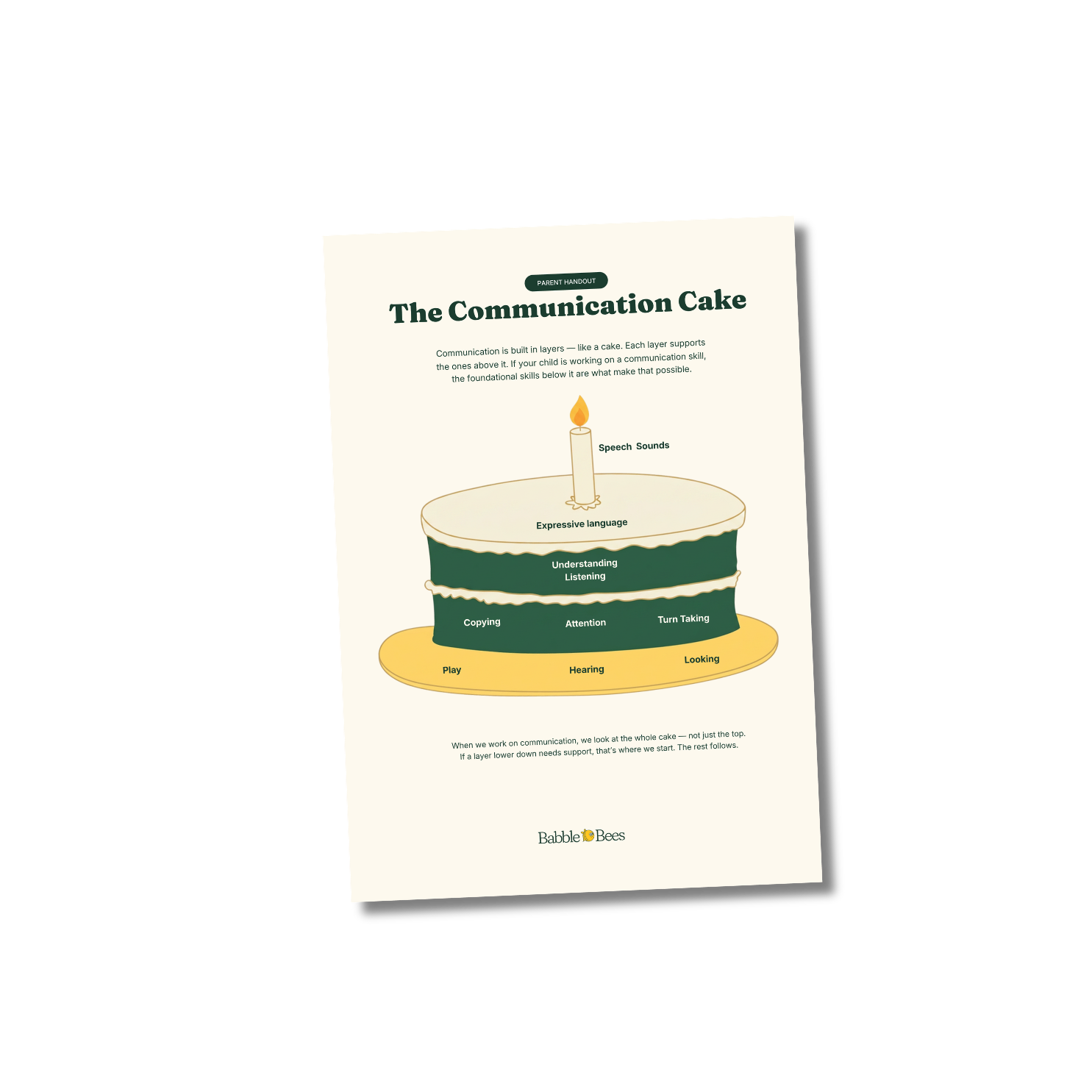
If you're in therapy with us and wondering where your child's current goals sit in this picture, bring it to your next session. It's a good conversation to have.